
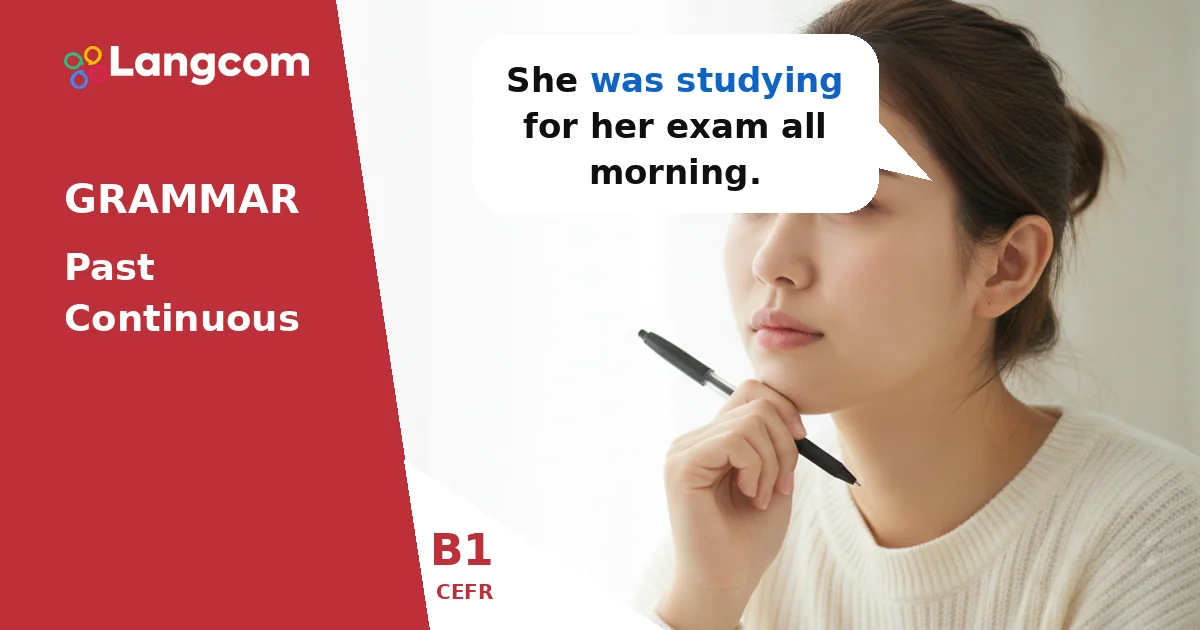

What is the Past Continuous Tense?
ال Past Continuous tense (also called Past Progressive) describes actions that were happening over a period of time in the past.
Imagine a snapshot of a moment in the past. The Past Continuous tells you what was in progress in that picture.
- It shows an action that started before a specific past moment and continued through it.
- It often sets the scene for another shorter action in the Past Simple.
🎓 تعلم اللغة الإنجليزية باستخدام الطريقة المختلطة
مجموعات صغيرة · مدرس ذكاء اصطناعي متاح على مدار الساعة · التحضير لامتحانات كامبريدج
خطط من $39 $79 في الشهر
How Do We Form the Past Continuous Tense?
Forming the Past Continuous is simple. You need two parts:
- ال Past Simple of the verb to be (was أو were).
- ال -ing form of the main verb (the present participle).
Look at the table below for positive, negative, and question forms.
When Do We Use the Past Continuous?
نحن نستخدم Past Continuous in several key situations:
- To describe an action in progress at a specific time in the past: This is the most common use. The action started before that time and was still happening.
- At 8 PM last night, I was eating dinner. (The action of eating was happening at 8 PM.)
- To describe a longer action interrupted by a shorter action: The longer action is in the Past Continuous, and the shorter, interrupting action is in the Past Simple.
- I was walking home when it started to rain. (Walking was the longer action, rain was the interruption.)
- To set the scene or provide background information in a story: It describes the general atmosphere or what was happening around the main events.
- The sun was shining, and the birds were singing as I left the house.
- To talk about two or more actions happening at the same time in the past: غالبًا ما نستخدم while أو as for this.
- While she was reading, he was watching TV.
Past Continuous vs. Past Simple: What's the Difference?
It's important to understand the difference between these two tenses. They often appear together in sentences.
- ال Past Simple describes a completed action in the past. It tells us that something happened.
- ال Past Continuous describes an action that was in progress at a specific time in the past. It tells us what was happening.
Think of it this way:
- I cooked dinner. (The action of cooking is finished.)
- I was cooking dinner when my friend arrived. (The action of cooking was ongoing when the friend arrived.)
غالبًا ما نستخدم when أو while to connect these two tenses:
- الاستخدام when with the Past Simple for the interrupting action.
- الاستخدام while with the Past Continuous for the longer, ongoing action.
| الموضوع | Positive (+) | Negative (-) | Yes/No Question (?) |
|---|---|---|---|
| I / He / She / It | was + verb-ing | wasn't + verb-ing | Was I/he/she/it + verb-ing? |
| You / We / They | were + verb-ing | weren't + verb-ing | Were you/we/they + verb-ing? |
أمثلة
- She was studying for her exam all morning.
- What were you doing at 7 PM yesterday?
- They weren't listening when the teacher explained the task.
- Was he sleeping when you called him?
- While I was driving, I saw an accident.
- The children were playing in the park when it started to rain.
- My parents were watching a movie while I was cooking dinner.
- He was always complaining about his job.
التدريب
✍️ لست متأكدًا من مستواك؟
خُذ اختبار تحديد المستوى المجاني الخاص بنا واحصل على تعليقات مخصصة من ممتحنين معتمدين من كامبريدج.
قم بإجراء اختبار تحديد المستوى المجانيالأخطاء الشائعة لدى المتحدثين باللغة الإسبانية
Spanish speakers sometimes make specific mistakes with the Past Continuous:
- Confusing it with the Past Simple for ongoing actions:
- خطأ: I studied when you called. (Sounds like you finished studying before the call.)
- الصحيح: I was studying when you called. (Shows the action was in progress.)
- Using the wrong form of to be:
- خطأ: She were reading.
- الصحيح: She was reading.
- Forgetting the -ing form:
- خطأ: They were watch TV.
- الصحيح: They were watching TV.
- Direct translation from Spanish "estaba + gerundio": While often similar, be careful with verbs that describe states (stative verbs) which usually don't use continuous forms.
- خطأ: I was knowing the answer.
- الصحيح: I knew the answer. (Know is a stative verb.)
الأسئلة الشائعة
Can I use the Past Continuous for very short actions?
No, the Past Continuous is for actions that have duration. For very short, completed actions, use the Past Simple. على سبيل المثال،, The phone rang (Past Simple), not The phone was ringing if you mean a single ring.
What's the difference between 'I was doing' and 'I did'?
I was doing means the action was in progress at a specific time in the past (e.g., I was cooking dinner when he arrived). I did means the action was completed in the past (e.g., I cooked dinner yesterday).
Can I use the Past Continuous with 'always'?
نعم، يمكنك استخدام always with the Past Continuous to talk about repeated actions that were annoying or surprising in the past. For example, He was always losing his keys.



0 تعليق