

What Are Tone Groups?
In English, we don’t speak in a continuous stream of words. Instead, we break our sentences into smaller units. These units are called tone groups, also known as intonation units oder sense groups.
- Each tone group usually represents a single idea or piece of information.
- It typically contains one main stressed syllable, called the nucleus, where the most significant pitch change occurs.
- Tone groups are often separated by very slight pauses, which help the listener process the information.
The intonation pattern (rising, falling, or fall-rise) of the tone group starts before the nucleus and continues until the end of the group.
✍️ Du bist dir nicht sicher, auf welchem Niveau du bist?
Machen Sie unseren kostenlosen Einstufungstest und erhalten Sie individuelles Feedback von zertifizierten Cambridge-Prüfern.
Machen Sie unseren KOSTENLOSEN EinstufungstestWhy Are Tone Groups Important for B2 Learners?
Understanding and using tone groups correctly is vital for advanced English learners. They impact both how you sound and how well you are understood.
- Clarity: They help listeners follow your ideas by breaking down long sentences into manageable parts.
- Meaning: The way you group words and where you place the main stress can change the meaning of your sentence.
- Naturalness: Correct tone groups make your speech sound more fluent, natural, and less robotic.
- Emphasis: You can highlight important information by placing it in the nucleus of a tone group.
At B2 level, you are expected to communicate complex ideas clearly. Correct tone groups are a key part of achieving this.
How to Identify Tone Groups in Spoken English
You can often identify tone groups by listening for these features:
- Pauses: There is often a very brief pause before a new tone group begins.
- Stress: Each tone group has one primary stressed word, the nucleus. This word carries the most important new information.
- Intonation Changes: The pitch of your voice often changes significantly on or after the nucleus. It might rise, fall, or do both.
- Grammar: Tone groups often correspond to grammatical units like clauses, long phrases, or items in a list.
Listen carefully to native speakers. You will notice these patterns naturally.
Common Patterns and Examples
Tone groups frequently occur in specific grammatical contexts:
- Longer Sentences: Complex sentences are almost always broken into multiple tone groups.
- Clauses: Subordinate clauses (e.g., if clauses, relative clauses) are often separate tone groups.
- Lists: Each item in a list usually forms its own tone group.
- Introductory Phrases: Long introductory phrases or adverbs are often separated.
Practicing these patterns will help you internalize the rhythm of English.
Beispiele
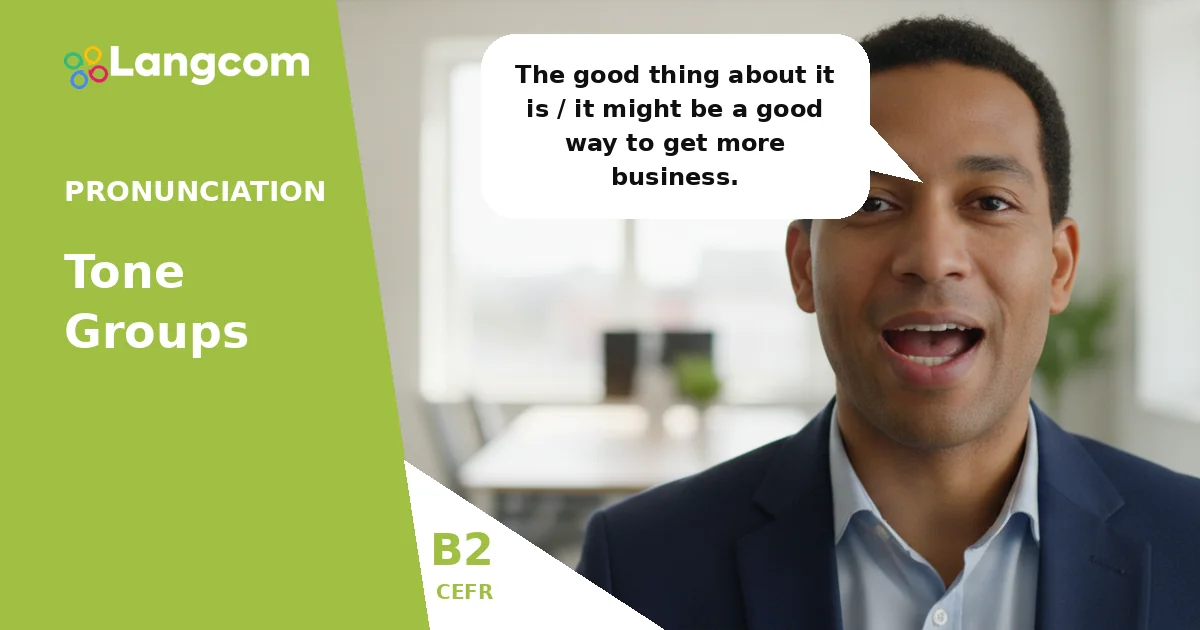
- The good thing about it is / it might be a good way to get more business.
- The trouble is / it means investing even more money.
- If you’re ready, / we can leave now.
- She bought apples, / bananas, / and oranges.
- Although it was raining, / they decided to go for a walk.
Übung
Bist du bereit, dein Zertifikat zu erwerben?
Der Kurs Langcom bereitet die Teilnehmer auf die Prüfungen von Cambridge, IELTS, TOEFL, DELE, SIELE und Michigan vor.
Erste Schritte mit LangcomHäufige Fehler bei Spanischsprechern
Spanish speakers sometimes make these mistakes with tone groups:
- Not Pausing Enough: Speaking long sentences without natural breaks can make your speech sound rushed and difficult to understand. English relies more on these pauses than Spanish.
- Flat Intonation: Not varying pitch enough within tone groups can make your speech sound monotonous. English uses intonation to convey meaning and emotion more prominently than Spanish.
- Incorrect Stress Placement: Placing the main stress (nucleus) on the wrong word can change the meaning or sound unnatural. For example, saying I want to BUY it statt I want to buy IT if ‘it’ is the new information.
- Transferring Spanish Rhythm: Spanish has a more syllable-timed rhythm, while English is stress-timed. This difference can lead to less distinct tone group boundaries if not practiced.
Häufig gestellte Fragen
What is the ‘nucleus’ in a tone group?
Die nucleus is the most important syllable in a tone group. It’s where the main pitch change occurs and usually carries the most significant new information or emphasis in that part of the sentence. For example, in I bought a NEW car, ‘new’ is the nucleus.
How do tone groups help with B2 speaking exams?
Tone groups are crucial for B2 speaking exams because they demonstrate your ability to speak clearly, naturally, and with appropriate emphasis. Correct use helps you convey complex ideas effectively, improving your fluency and coherence scores. Examiners listen for natural rhythm and intonation.
Can a tone group be just one word?
Yes, a tone group can sometimes be a single word, especially if that word is an answer to a question or carries strong emphasis. For example, if someone asks ‘Who’s there?’, the answer ‘Me!‘ would be a single tone group.
Is there a rule for where to pause between tone groups?
There isn’t a strict rule for every pause, but generally, pauses occur at natural grammatical breaks. These include between clauses (If it rains, / we’ll stay inside), after introductory phrases (To be honest, / I don’t agree), or before new pieces of information. Listening to native speakers is the best way to learn these natural breaks.


0 Kommentare