

Why are English Consonant Sounds Important for B2 Learners?
At the B2 level, you need to communicate effectively and understand native speakers in various situations. Accurate consonant pronunciation is fundamental for this.
- Clarity: Correct sounds ensure your words are understood, preventing misunderstandings.
- Confidence: Speaking clearly boosts your self-assurance in conversations.
- Listening: Recognizing subtle sound differences helps you understand spoken English better.
- Fluency: Good pronunciation contributes to a smoother, more natural flow in your speech.
✍️ ¿No sabes en qué nivel estás?
Realiza nuestra prueba de nivel gratuita y recibe comentarios personalizados de examinadores certificados por Cambridge.
Realice nuestra prueba de nivel GRATUITAWhat are Voiced and Voiceless Consonants?
This is a crucial concept for many English consonant sounds. It refers to whether your vocal cords vibrate when you make a sound.
- Voiced Sounds: Your vocal cords vibrate. You can feel a buzzing in your throat if you touch it while making the sound. Examples: /b/, /d/, /g/, /v/, /z/, /ð/, /ʒ/, /dʒ/.
- Voiceless Sounds: Your vocal cords do not vibrate. The sound comes only from the air passing through your mouth. Examples: /p/, /t/, /k/, /f/, /s/, /θ/, /ʃ/, /tʃ/.
Many English consonant sounds come in voiced/voiceless pairs, using the same mouth position but with or without vocal cord vibration.
How Do We Pronounce the Tricky ‘TH’ Sounds?
The ‘th’ sounds are often challenging because they don’t have direct equivalents in many languages, including Spanish. English has two distinct ‘th’ sounds.
- Voiceless /θ/:
- How to make it: Place the tip of your tongue gently between your upper and lower front teeth. Push air out without vibrating your vocal cords.
- Common spellings: th
- Examples: think, three, both, healthy, path
- Voiced /ð/:
- How to make it: The tongue position is the same as for /θ/, but you vibrate your vocal cords.
- Common spellings: th
- Examples: this, that, mother, breathe, although
Practice feeling the vibration in your throat to distinguish between them.
What’s the Difference Between ‘S’ and ‘Z’ Sounds?
These sounds are also a voiced/voiceless pair, and their distinction is important.
- Voiceless /s/:
- How to make it: The tip of your tongue is near the ridge behind your upper teeth, but not touching. Air flows out through a narrow gap. No vocal cord vibration.
- Common spellings: s, ss, ce, se
- Examples: say, class, city, house (noun)
- Voiced /z/:
- How to make it: The mouth position is the same as for /s/, but you vibrate your vocal cords.
- Common spellings: z, s (between vowels or at the end of plural nouns/verbs)
- Examples: zero, easy, goes, houses (plural)
Notice how the letter ‘s’ can represent both sounds depending on its position in a word.
How Do We Pronounce ‘SH’ and ‘ZH’ Sounds?
These are another voiced/voiceless pair, often confused by learners.
- Voiceless /ʃ/ (like ‘sh’ in ‘shop’):
- How to make it: Round your lips slightly. The middle of your tongue rises towards the roof of your mouth. Push air out. No vocal cord vibration.
- Common spellings: sh, ti, ci, ss
- Examples: shop, nation, special, pressure
- Voiced /ʒ/ (like ‘s’ in ‘measure’):
- How to make it: The mouth position is similar to /ʃ/, but you vibrate your vocal cords.
- Common spellings: s (in words like ‘measure’), ge (in some French loanwords)
- Examples: measure, vision, usual, genre
En /ʒ/ sound is less common in English than /ʃ/ but appears in many everyday words.
Understanding ‘CH’ and ‘J’ Sounds
These are “affricate” sounds, meaning they start like a stop sound (air is blocked) and release like a fricative (air flows through a narrow gap). They are also a voiced/voiceless pair.
- Voiceless /tʃ/ (like ‘ch’ in ‘choose’):
- How to make it: Touch the tip of your tongue to the ridge behind your upper teeth, then quickly release it while pushing air out. No vocal cord vibration.
- Common spellings: ch, tch
- Examples: choose, catch, future, question
- Voiced /dʒ/ (like ‘j’ in ‘jeans’):
- How to make it: The mouth position is the same as for /tʃ/, but you vibrate your vocal cords.
- Common spellings: j, g (before e, i, y), dg
- Examples: jeans, general, bridge, educate
These sounds require precise tongue and breath control.
Tips for Practicing English Consonant Sounds
Improving your pronunciation takes time and consistent effort. Here are some strategies:
- Listen Actively: Pay close attention to how native speakers pronounce these sounds in different words.
- Use a Mirror: Watch your mouth and tongue position to ensure you’re forming the sounds correctly.
- Record Yourself: Speak words and sentences, then listen back. Compare your pronunciation to a native speaker’s.
- Minimal Pairs: Practice words that differ by only one sound, like thin / tin, sip / zip, share / chair.
- Tongue Twisters: Fun phrases can help you practice difficult sounds repeatedly.
- Focus on Feeling: Pay attention to the vibration in your throat for voiced sounds.
| IPA Symbol | Sound Description | Common Spellings | Ejemplos |
|---|---|---|---|
| /θ/ | Voiceless ‘th’ | th | think, path |
| /ð/ | Voiced ‘th’ | th | this, mother |
| /s/ | Voiceless ‘s’ | s, ss, ce, se | say, class, city, house (noun) |
| /z/ | Voiced ‘z’ | z, s | zero, easy, houses (plural) |
| /ʃ/ | Voiceless ‘sh’ | sh, ti, ci, ss | shop, nation, special, pressure |
| /ʒ/ | Voiced ‘zh’ | s, ge | measure, vision, genre |
| /tʃ/ | Voiceless ‘ch’ | ch, tch | choose, catch, future |
| /dʒ/ | Voiced ‘j’ | j, g, dg | jeans, general, bridge |
Ejemplos
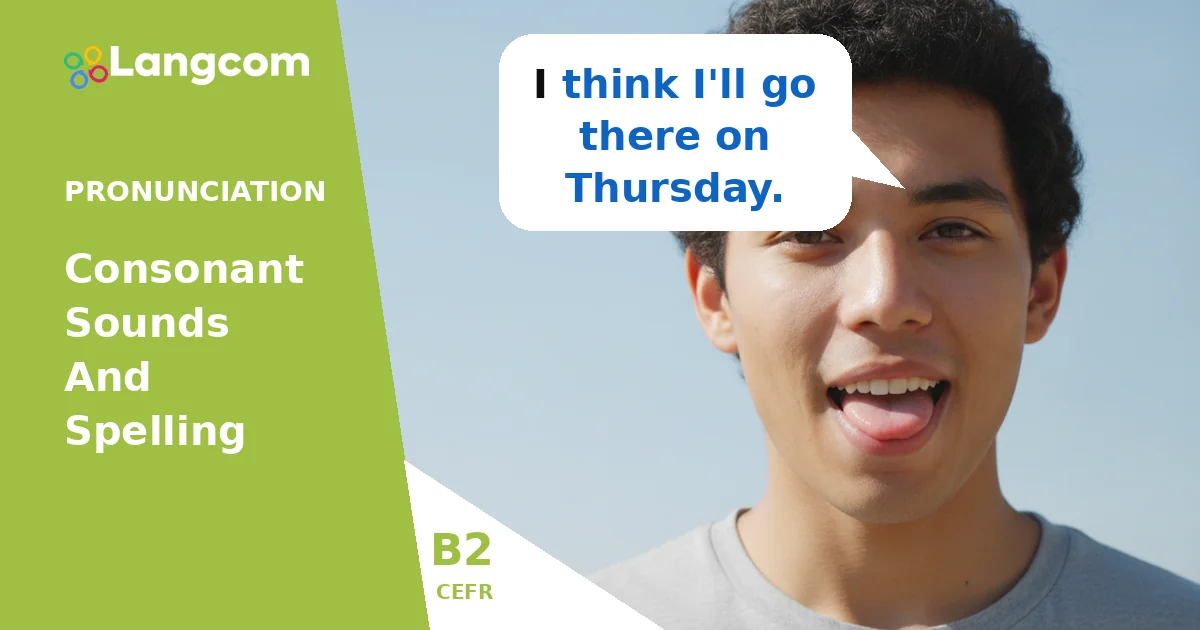
- I think I’ll go there on Thursday.
- She said she saw a zebra at the zoo.
- The chef chose to share the special dish.
- It’s a pleasure to measure the treasure.
- My brother breathes through his mouth when he sleeps.
- Can you imagine a huge bridge in the jungle?
- The decision was made with great precision.
- They need both health and wealth.
Práctica
¿Estás listo para obtener tu certificado?
El curso Langcom prepara a los alumnos para los exámenes de Cambridge, IELTS, TOEFL, DELE, SIELE y Michigan.
Empieza a utilizar LangcomErrores habituales de los hispanohablantes
Spanish speakers often face specific challenges with these English consonant sounds:
- ‘TH’ Sounds (/θ/ y /ð/):
- Many Spanish speakers replace /θ/ with /t/ o /f/. Por ejemplo, think might sound like tink o fink.
- /ð/ is often replaced by /d/. So, this might sound like dis. Remember to put your tongue between your teeth for both ‘th’ sounds.
- ‘S’ vs ‘Z’ (/s/ y /z/):
- In many Spanish dialects, ‘s’ is often voiced, similar to English /z/, especially before voiced consonants. This can lead to pronouncing all ‘s’ sounds as /z/ in English. For example, house (noun) might be pronounced with a /z/ sound instead of /s/.
- Pay attention to the vibration for /z/ and the lack of it for /s/.
- ‘SH’ (/ʃ/) and ‘CH’ (/tʃ/):
- Sometimes, /ʃ/ can be confused with /tʃ/, or vice-versa. For instance, ship might sound like chip.
- Remember that /tʃ/ is a combination of /t/ y /ʃ/, a quicker, more abrupt sound.
- ‘J’ (/dʒ/):
- The English /dʒ/ sound (as in jeans) is very different from the Spanish ‘j’ sound (which is closer to /h/ in English).
- Spanish speakers might substitute /dʒ/ with /ʝ/ (like ‘y’ in yo) or even /tʃ/. Focus on the initial stop and voiced release for /dʒ/.
Preguntas más frecuentes
What is the main difference between voiced and voiceless sounds?
The main difference is whether your vocal cords vibrate. For voiced sounds, your vocal cords vibrate, creating a buzzing feeling in your throat. For voiceless sounds, they do not vibrate; the sound comes only from the air.
How can I tell if a ‘th’ sound is voiced or voiceless?
You can feel it! Place your hand on your throat. If you say think, you won’t feel vibration for the ‘th’ (/θ/). If you say this, you will feel a vibration for the ‘th’ (/ð/).
Are there clear rules for spelling these consonant sounds?
Unfortunately, English spelling is not always consistent with pronunciation. For example, the ‘s’ in house is /s/, but in houses, it’s /z/. The ‘sh’ sound can be spelled sh, ti, o ci. You need to learn common patterns and practice listening.
Why is mastering these specific consonant sounds important for B2 English?
At B2, you are expected to communicate with a good degree of fluency and accuracy. Distinguishing and correctly producing these sounds helps you avoid misunderstandings, sound more natural, and improve your overall comprehension when listening to native speakers. It’s a key part of developing advanced communication skills.




0 Comentarios