

What Are Verb-Noun Collocations and Why Are They Important?
Collocations are simply words that often go together. Think of them as word friends. When a verb and a noun frequently appear together, they form a verb-noun collocation.
These partnerships are not always logical, so you cannot guess them. For example, in Spanish, you might say ‘hacer una foto’, but in English, we say take a photo, no make a photo.
- Sound Natural: Using correct collocations makes your English sound more authentic, like a native speaker.
- Improve Fluency: When you know common collocations, you don’t have to think about each word separately, which makes you speak and write more smoothly.
- Boost Exam Scores: For B2 exams like the FCE, using a range of appropriate vocabulary, including collocations, is essential for higher marks in all papers.
✍️ ¿No sabes en qué nivel estás?
Realiza nuestra prueba de nivel gratuita y recibe comentarios personalizados de examinadores certificados por Cambridge.
Realice nuestra prueba de nivel GRATUITAEssential Verb Collocations for B2 Learners
Let's explore some common verb collocations that are very useful at the B2 level, including those you might find in your exercises.
Do Collocations
The verb do often combines with nouns related to tasks, activities, or performance.
- Do a favour: Could you do me a favour and help me move this box?
- Do business: They do business with companies all over the world.
- Do research: She is doing research for her university project.
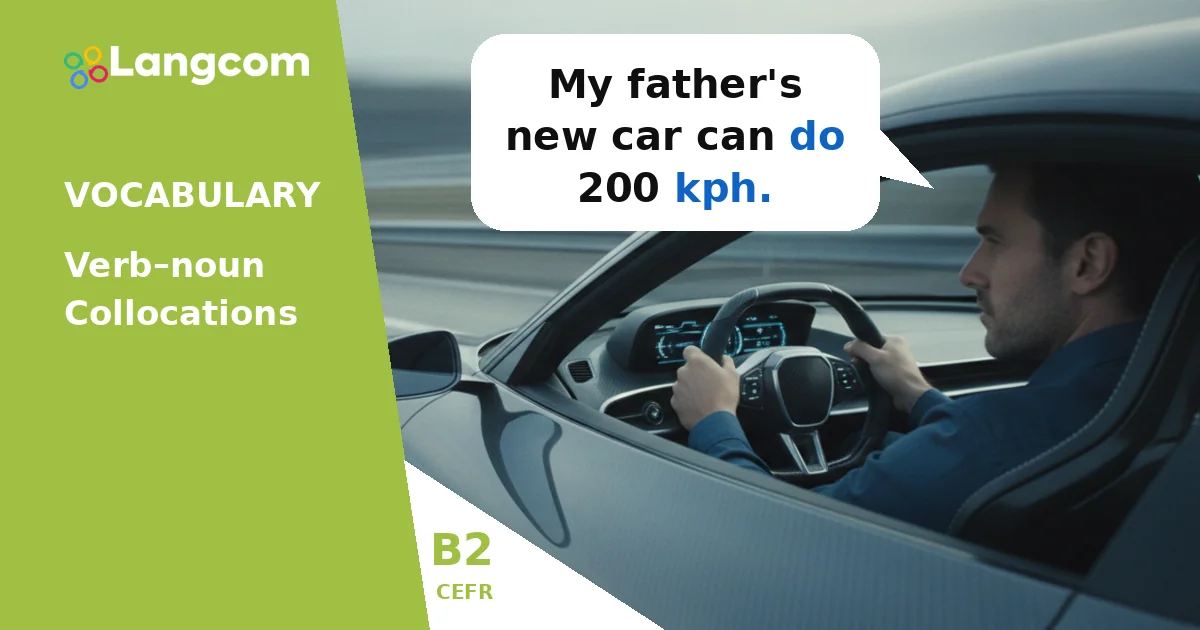
- Do + speed/distance: My car can do 200 kph. / This engine does 25 km to the litre.
Make Collocations
The verb make often relates to creating, producing, or deciding.
- Make a decision: It's time to make a decision about our holiday.
- Make a mistake: Everyone makes mistakes sometimes.
- Make progress: We are making good progress on the project.
- Make a fortune: He made a fortune from his new software company.
Have Collocations
The verb have is used for experiences, meals, and certain activities.
- Have a party: We're having a party next Saturday.
- Have a dream: I had a strange dream last night.
- Have a good time: I hope you have a good time at the concert.
- Have a holiday: We're having a holiday in South America this year.
Break Collocations
The verb break often means to violate, interrupt, or exceed.
- Break a record: The athlete broke the world record.
- Break the ice: A joke can help to break the ice in a new group.
- Break a promise: It's important not to break a promise.
Keep Collocations
The verb keep often means to maintain, continue, or store.
- Keep a secret: Can you keep a secret?
- Keep a promise: He always keeps his promises.
- Keep awake: The loud music kept me awake all night.
Spend Collocations
The verb spend is used for using time or money.
- Spend time: I love spending time with my family.
- Spend money: She spends too much money on clothes.
- Spend a fortune: People always seem to spend a fortune when they go on holiday.
Taste Collocations
The verb taste is a linking verb, often followed by an adjective to describe flavour.
- Taste good/bad: This ice cream tastes really good. / The soup tastes bad.
- Taste funny: This cheese tastes a bit funny.
- Taste sweet/salty: The cake tastes very sweet.
How Do Collocations Help You in the B2 First (FCE) Exam?
Collocations are vital for achieving a good score in the B2 First (FCE) exam:
- Speaking Paper: Using natural collocations makes your speech more fluent and sophisticated. It shows the examiner you can use English accurately and appropriately.
- Writing Paper: Correct collocations improve the coherence and style of your essays, emails, and reports. They demonstrate a wider range of vocabulary.
- Use of English Paper: Some tasks directly test your knowledge of collocations, requiring you to choose the correct word to complete a phrase.
By actively learning collocations, you are preparing yourself to communicate more effectively and impress examiners with your advanced English skills.
| Verbo | Noun Collocation |
|---|---|
| do | a favour, business, research, 200 kph |
| make | a decision, a mistake, progress, a fortune |
| have | a party, a dream, a good time, a holiday |
| break | a record, the ice, a promise, the law |
| keep | a secret, a promise, calm, awake |
| spend | time, money, a fortune |
| taste | good, funny, sweet |
Ejemplos
- My father's new car can do 200 kph.
- I don't like people who break their promises.
- We're having a holiday in South America this year.
- Maximo made a fortune from computer software.
- The music from the festival kept me awake for ages last night.
- This ice cream tastes really good.
- Liliana spends too much time at her friend's house.
- I had loads of camping holidays when I was young.
- His speech was so boring it was all I could do to keep awake.
Práctica
¿Estás listo para obtener tu certificado?
El curso Langcom prepara a los alumnos para los exámenes de Cambridge, IELTS, TOEFL, DELE, SIELE y Michigan.
Empieza a utilizar LangcomErrores habituales de los hispanohablantes
Spanish speakers often make mistakes with verbs like make y do, o have y take, because the direct translation from Spanish might not be the correct collocation in English.
- Make vs. Do: In Spanish, 'hacer' can mean both make y do. Remember to use make a decision (NOT do a decision) and do homework (NOT make homework).
- Have vs. Take: While you can take a holiday, the exercise focuses on have a holiday. Also, we say have a shower (o take a shower), but not always interchangeably for all nouns. For example, have a party is more common than take a party.
- Direct Translation: Avoid translating word-for-word. For example, 'romper una promesa' translates to break a promise, which is correct. But 'gastar tiempo' is spend time, not 'waste time' if you mean to use it.
Preguntas más frecuentes
What is a collocation in English?
A collocation is a pair or group of words that are habitually used together. They sound natural to native speakers, such as heavy rain, no strong rain.
How can I learn collocations effectively?
You can learn collocations by reading a lot, noting down new word pairs in context, using a collocation dictionary, and practicing them in your speaking and writing. Try to learn them as chunks, not individual words.
Are collocations important for the B2 First (FCE) exam?
Yes, absolutely! Collocations are crucial for the B2 First (FCE) exam. They are tested in the Use of English paper, and using them correctly will significantly improve your scores in the Speaking and Writing papers by making your language more natural and accurate.
Is there a rule for collocations?
Unfortunately, there are no strict grammatical rules for collocations. They are largely arbitrary, meaning you need to learn them through exposure and memorization, much like irregular verbs. However, recognizing common patterns can help.

0 Comentarios