

What Are Prepositions of Place?
Prepositions of place are small words that show the position or location of a noun or pronoun. They answer the question ‘Where?’
These words are essential for describing where things are in the world. They help us understand the exact relationship between different objects or people.
✍️ Non sai a quale livello ti trovi?
Fai il nostro test di livello gratuito e ricevi un feedback personalizzato da esaminatori certificati Cambridge.
Fai il nostro test di livello GRATUITOWhen to Use At, In, e On?
These three prepositions are very common and can be confusing. Each one has specific uses for different types of locations.
- At: For a specific point or general location.
- Utilizzo at for precise addresses: I live at 24 Oak Street.
- Utilizzo at for specific points or public places: She is at the bus stop., They are at the airport.
- Utilizzo at for events: We met at the concert.
- In: For enclosed spaces or larger areas.
- Utilizzo in for countries, cities, and large geographical areas: He lives in Spain., I found a bank in the town centre.
- Utilizzo in for rooms or buildings (when inside): The books are in the library., I'm in the kitchen.
- Utilizzo in for vehicles like cars or taxis: She's in the car.
- On: For surfaces or lines.
- Utilizzo on for surfaces: The book is on the table., There was a notice on the wall.
- Utilizzo on for public transport (buses, trains, planes): We are on the bus.
- Utilizzo on for floors or roofs: The hotel had a big swimming pool on its roof.
How to Use Across, Into, e Off?
These prepositions often describe movement or a more specific relationship between objects.
- Across: From one side to the other.
- Utilizzo across to describe movement from one side of something to the other: We walked across the bridge., We showed our passports as we went across the frontier.
- Into: Movement from outside to inside.
- Utilizzo into to show entry or movement from an exterior to an interior: He walked into the room., I jumped into the pool to cool off.
- Off: Separation or location near a coast.
- Utilizzo off to indicate separation from a surface or a place: He fell off his bike.
- Utilizzo off to describe an island or location near a coast: Singapore is an island off the coast of Malaysia.
| Preposition | Main Use | Example |
|---|---|---|
| At | Specific point, address, general location, event | Meet me at the cafe. |
| In | Enclosed space, larger area (city, country), inside a car/taxi | The cat is in the box. |
| On | Surface, line, public transport (bus, train, plane), floor/roof | The book is on the shelf. |
| Across | Movement from one side to another | Walk across the street. |
| Into | Movement from outside to inside | He walked into the room. |
| Off | Separation from a surface; location near a coast | The apple fell off the tree. |
Esempi
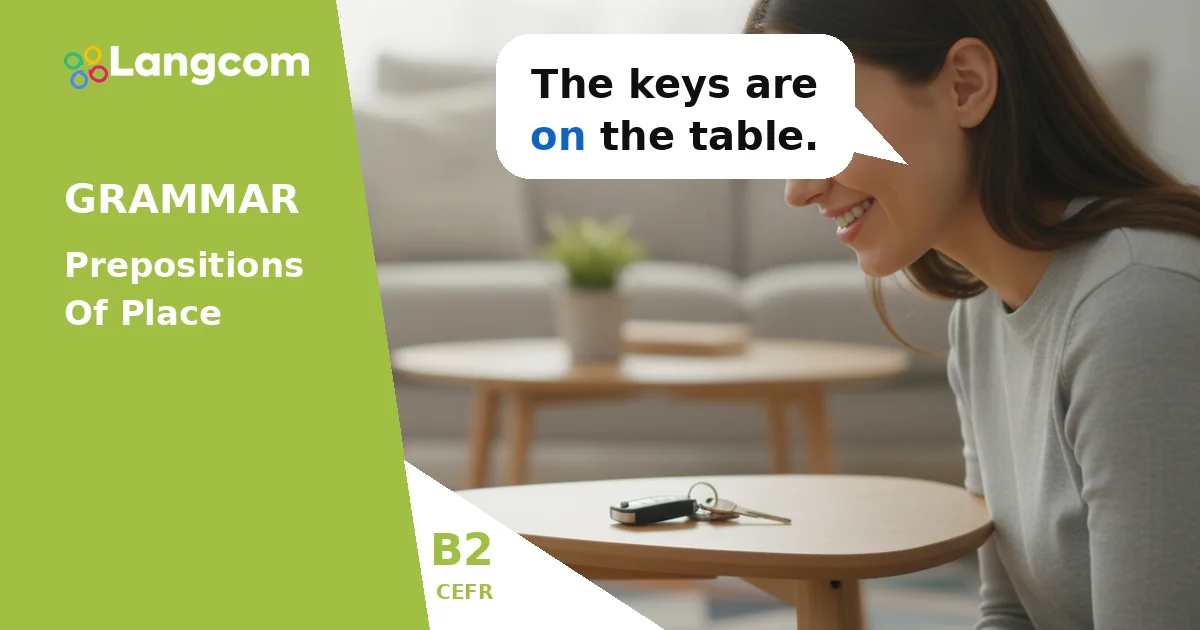
- The keys are on the table.
- She is waiting at the entrance.
- They live in a small village.
- He swam across the lake.
- The cat jumped into the box.
- Please take your feet off the sofa.
- I arrived in London last week.
- We sat on the terrace drinking a beer.
Esercitazione
Ready to earn your certificate?
Langcom prepares students for Cambridge, IELTS, TOEFL, DELE, SIELE and Michigan exams.
Get started with LangcomErrori comuni per chi parla spagnolo
Spanish speakers often make specific mistakes with prepositions of place due to differences between English and Spanish.
- Confuso in e at: In Spanish, 'en' can cover both 'in' and 'at'. Remember:
- I am in the hospital (I am a patient or working there).
- I am at the hospital (I am visiting or waiting outside).
- Using in for surfaces: In Spanish, 'en' can mean 'on' a surface. Always use on for surfaces.
- Errato: The picture is in the wall.
- Corretto: The picture is on the wall.
- Not using into for movement: When moving from outside to inside, English requires into, not just in.
- Errato: She went in the room.
- Corretto: She went into the room.
- Using on for small vehicles: Ricordati di usare in for cars and taxis, but on for public transport.
- Errato: I am on the car.
- Corretto: I am in the car.
Domande frequenti
What is the main difference between 'in' and 'on' for locations?
Utilizzo in for enclosed spaces or larger areas like cities and countries. Use on for surfaces, lines, or public transport like buses and trains.
When should I use 'at' instead of 'in' or 'on'?
Utilizzo at for specific points, precise addresses, or general locations like at the station oppure at home. It indicates a precise spot rather than an enclosed space or a surface.
How do 'across' and 'into' differ from 'in' and 'on'?
Across e into typically describe movement. Across means moving from one side to the other, while into means moving from outside to inside. In e on usually describe a static position.
Are prepositions of place important for the B2 First (FCE) exam?
Yes, prepositions of place are very important for the B2 First (FCE) exam. You might find them in the Use of English Part 1 (Multiple-choice cloze) or Part 2 (Open cloze) where you need to choose or provide the correct preposition to complete a sentence accurately.




0 Commenti