

What Are Gerunds and Infinitives in English?
A gerund is the -ing form of a verb that acts like a noun. It can be the subject or object of a sentence.
For example, in Swimming is good exercise, swimming is a gerund acting as the subject.
An infinitive is the base form of a verb, usually with to before it.
For instance, in I want to swim, to swim is an infinitive.
✍️ Non sai a quale livello ti trovi?
Fai il nostro test di livello gratuito e ricevi un feedback personalizzato da esaminatori certificati Cambridge.
Fai il nostro test di livello GRATUITOWhen Do We Use the -ing Form (Gerunds)?
We use the -ing form after certain verbs.
Common verbs include:
- enjoy: I enjoy watching movies.
- finish: She finished studying late.
- mind: Do you mind opening the window?
- miss: He misses playing football.
- keep: Keep trying!
We also use the -ing form after prepositions.
Examples of prepositions are for, of, about, at, in.
- Thanks for helping me.
- I'm good at speaking English.
- She's interested in learning French.
When Do We Use to + Infinitive?
Utilizziamo to + infinitive after certain verbs.
Common verbs include:
- hope: I hope to see you soon.
- want: They want to buy a new car.
- learn: He is learning to play the guitar.
- offer: She offered to help me.
- choose: We chose to stay home.
- help: Can you help me to carry this?
We also use to + infinitive after adjectives.
This often happens with be + adjective.
- I'm happy to be here.
- It's difficult to understand.
- She was surprised to hear the news.
Utilizziamo to + infinitive after would like, would love, would hate.
- I would like to drink some water.
- They would love to visit Paris.
| Verbs followed by <span data-no-translation>-ing</span> (Gerund) | Verbs followed by <span data-no-translation>to + Infinitive</span> |
|---|---|
| enjoy | hope |
| finish | want |
| mind | learn |
| miss | offer |
| keep | choose |
| help |
Esempi
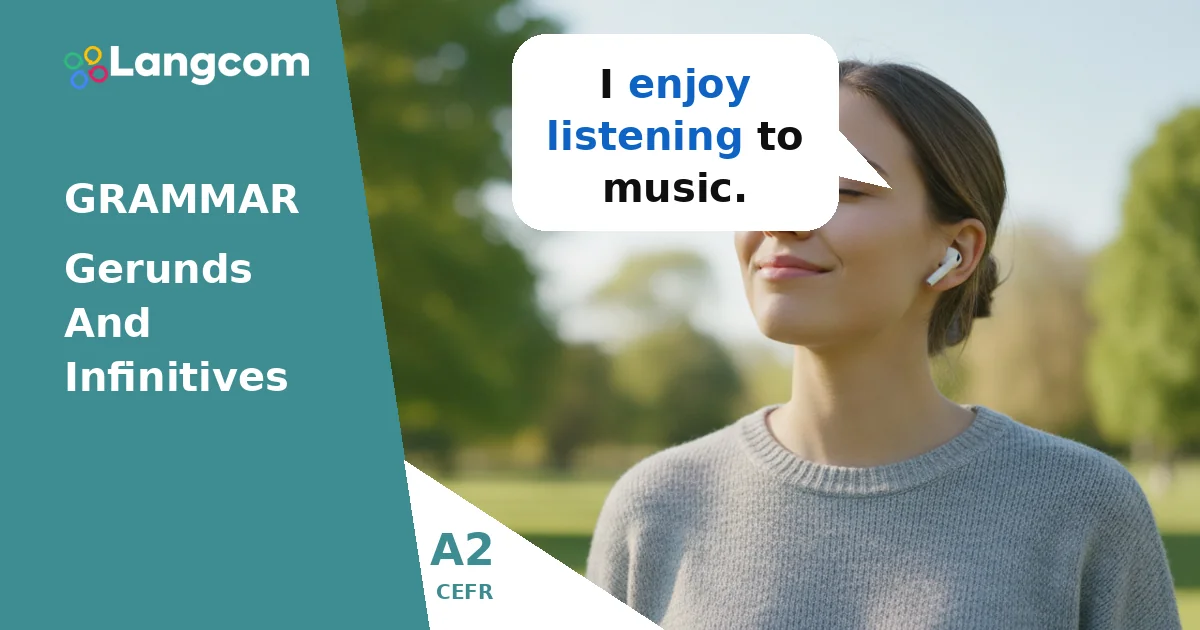
- I enjoy listening to music.
- She wants to learn French.
- He finished cleaning his room.
- We hope to travel next summer.
- Are you good at cooking?
- It's important to study every day.
- They offered to help with the project.
- I would love to go to the party.
Esercitazione
Ready to earn your certificate?
Langcom prepares students for Cambridge, IELTS, TOEFL, DELE, SIELE and Michigan exams.
Get started with LangcomErrori comuni per chi parla spagnolo
Spanish speakers often use the infinitive where English uses the gerund, especially after prepositions.
For example, a common mistake is I am good at speak English (incorrect).
The correct form is I am good at speaking English, because at is a preposition, and it must be followed by the -ing form.
Another common error is using -ing after verbs that require to + infinitive.
For instance, I want going home (incorrect).
The correct form is I want to go home, as want is followed by to + infinitive.
Domande frequenti
What is the main difference between a gerund and an infinitive?
A gerund is the -ing form of a verb that acts like a noun, for example, Reading is fun. An infinitive is to + base verb, and it often expresses purpose or follows certain verbs, like I want to read.
How can I remember which verbs take -ing and which take to + infinitive?
The best way is to learn common verbs in groups and practice. Start with the verbs in the table above. Reading and listening to English will also help you naturally remember the correct forms.
Will I see gerunds and infinitives in the A2 Key (KET) exam?
Yes, you might. For example, in Part 7 of the Reading and Writing paper, you might need to complete sentences with the correct verb form, which could include choosing between -ing oppure to + infinitive.



0 Commenti