

Why is Precise Emotional Vocabulary Important at C1?
At the C1 level, your English should reflect a deep understanding of human emotions. Using precise vocabulary helps you communicate complex ideas and feelings effectively.
- It allows you to describe people’s reactions with greater accuracy.
- You can express subtle differences in mood and temperament.
- This precision makes your spoken and written English more sophisticated and natural.
✍️ Not sure which level you are?
Take our free placement test and get personalized feedback from certified Cambridge examiners.
Пройдите наш БЕСПЛАТНЫЙ тест на определение местаDescribing Calmness and Positive Traits
Some words describe people who handle situations well or show positive character traits.
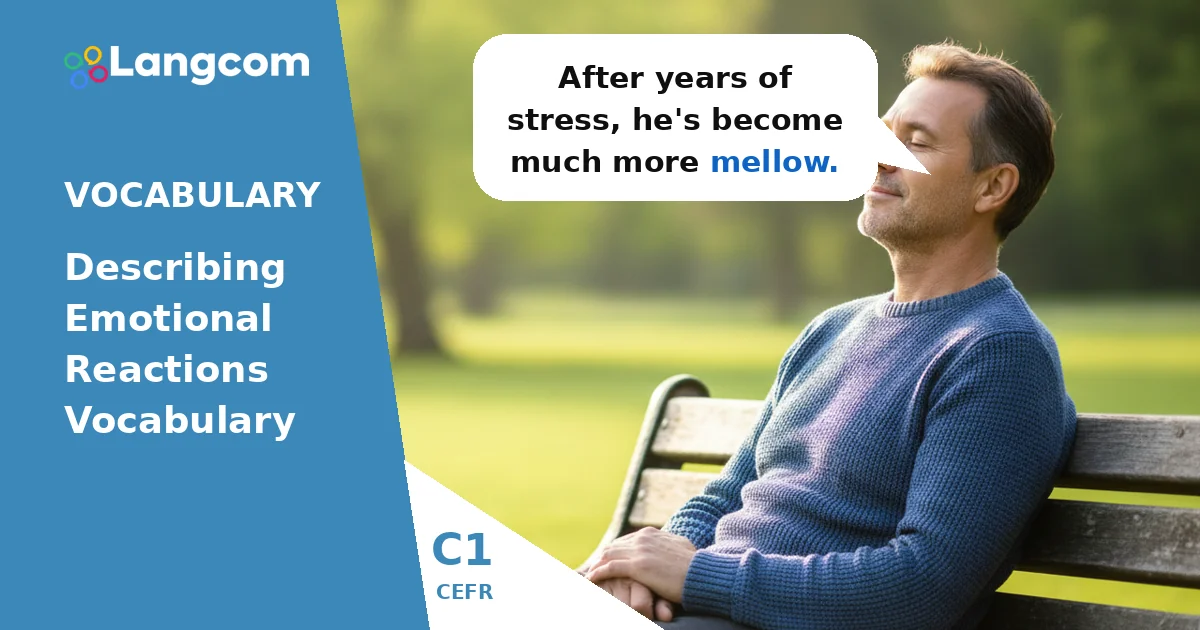
- Mellow: Describes someone who is calm, relaxed, and not easily upset, often becoming more so with age.
- Пример: After years of stress, he’s become much more mellow.
- Composed: Means being calm and in control of your emotions, even in difficult situations.
- Пример: Despite the bad news, she remained perfectly composed.
- Gracious: Refers to being polite, kind, and pleasant, especially towards others, even when you are in a position of power or have been wronged.
- Пример: The losing team was gracious in defeat, congratulating their opponents.
- Forgiving: Describes someone who is ready and willing to forgive others for their mistakes or offenses.
- Пример: She has a very forgiving nature and rarely holds a grudge.
Words for Problem-Solving and Success
These words highlight a person’s ability to overcome challenges and achieve good results.
- Resourceful: Describes someone who is good at finding quick and clever ways to overcome difficulties. They can think creatively to solve problems.
- Пример: When the power went out, she was resourceful and found candles and a battery-powered radio.
- Victorious: Means having won a victory or achieved success. It implies a feeling of triumph.
- Пример: The team felt victorious after winning the championship game.
Describing Intense or Negative Emotional Reactions
These terms describe reactions that are often seen as negative, showing a lack of control or harmful intent.
- Flustered: Means feeling agitated, confused, or nervous, often because you are in a hurry or under pressure.
- Пример: He got flustered when the interviewer asked a difficult question.
- Hysterical: Describes someone who is uncontrollably emotional, often with extreme fear, anger, or excitement. It can involve crying or laughing uncontrollably.
- Пример: She became hysterical when she realized her passport was missing.
- Melodramatic: Refers to someone who is exaggeratedly emotional or dramatic, often making a situation seem more serious than it is.
- Пример: His reaction to a small scratch was completely melodramatic.
- Spiteful: Means showing a desire to harm, annoy, or humiliate someone, often because you are angry or jealous.
- Пример: She made a spiteful comment about his new haircut.
- Defensive: Describes someone who is quick to protect themselves from criticism or attack, often by arguing or justifying their actions.
- Пример: When I offered advice, he immediately became defensive.
Understanding “Harmless”
Harmless is a useful word to describe something that does not cause or is not likely to cause any damage, injury, or offense. It’s often used to reassure someone.
- Пример: Don’t worry, the spider is completely harmless.
- Пример: It was just a harmless joke, nobody was offended.
How to Choose the Right Word for Emotional Reactions
Selecting the best word depends on the specific context and the intensity of the emotion.
- Consider the degree of emotion: Is it mild (mellow) or extreme (hysterical)?
- Think about the person’s intent: Are they trying to be kind (gracious) or cause harm (spiteful)?
- Evaluate the situation: Is it a problem-solving scenario (resourceful) or a moment of triumph (victorious)?
Practicing with these words will help you develop a more nuanced and sophisticated vocabulary for describing emotional states.
| Слово | Connotation | Core Meaning |
|---|---|---|
| Mellow | Positive | Calm, relaxed, easygoing |
| Composed | Positive | Calm and in control, especially under pressure |
| Forgiving | Positive | Willing to pardon mistakes or offenses |
| Gracious | Positive | Polite, kind, and pleasant |
| Resourceful | Positive | Good at finding solutions to difficulties |
| Victorious | Positive | Having won a victory; triumphant |
| Harmless | Neutral/Positive | Not causing damage, injury, or offense |
| Defensive | Negative | Quick to protect oneself from criticism |
| Flustered | Negative | Agitated, confused, or nervous |
| Hysterical | Negative | Uncontrollably emotional (fear, anger, excitement) |
| Melodramatic | Negative | Exaggeratedly emotional or dramatic |
| Spiteful | Negative | Desiring to harm, annoy, or humiliate |
Примеры
- After years of stress, he’s become much more mellow.
- Despite the bad news, she remained perfectly composed.
- The losing team was gracious in defeat, congratulating their opponents.
- She has a very forgiving nature and rarely holds a grudge.
- When the power went out, she was resourceful and found candles and a battery-powered radio.
- The team felt victorious after winning the championship game.
- He got flustered when the interviewer asked a difficult question.
- She became hysterical when she realized her passport was missing.
- His reaction to a small scratch was completely melodramatic.
- She made a spiteful comment about his new haircut.
- When I offered advice, he immediately became defensive.
- Don’t worry, the spider is completely harmless.
- It was just a harmless joke, nobody was offended.
- Even after the argument, she was gracious enough to offer help.
- He’s a very mellow person, always calm and easygoing.
Практика
Ready to earn your certificate?
Langcom prepares students for Cambridge, IELTS, TOEFL, DELE, SIELE and Michigan exams.
Get started with LangcomРаспространенные ошибки у носителей испанского языка
Spanish speakers sometimes use words that are too strong or too weak for the intended emotional reaction. Be careful with these common errors:
- Hysterical vs. Very Upset: In Spanish, “histérico/a” might sometimes describe someone who is simply very upset or crying a lot. In English, hysterical means an uncontrollable, extreme emotional outburst, often involving irrational behavior.
- Wrong: She was hysterical because she missed the bus. (Unless she was truly out of control.)
- Right: She was very upset because she missed the bus.
- Right: She became hysterical when she saw the house on fire.
- Melodramatic vs. Dramatic: While “dramático/a” in Spanish can be neutral, melodramatic in English almost always implies an exaggerated, over-the-top emotional reaction that is not genuine or necessary.
- Wrong: Her speech was very melodramatic. (If you mean powerful and effective.)
- Right: Her speech was very dramatic.
- Right: He was being melodramatic about a small cut on his finger.
- Confusing Spiteful with Angry: Spiteful is more specific than just being angry. It means wanting to hurt or annoy someone deliberately because you are angry or jealous.
- Wrong: He was spiteful about losing the game. (Unless he tried to harm the winner.)
- Right: He was angry about losing the game.
- Right: He left a spiteful note on her car after their argument.
Часто задаваемые вопросы
What is the difference between mellow and composed?
Mellow describes a general personality trait of being calm, relaxed, and easygoing, often developing with age. For example, My grandfather is a very mellow man. Composed describes a state of being calm and in control of your emotions in a specific, often difficult, situation. For example, She remained composed during the crisis.
Can defensive ever be a positive trait?
Generally, defensive has a negative connotation, implying someone is too quick to justify themselves or react to criticism. However, in a very specific context, like “a defensive strategy,” it can be neutral. When describing a person’s emotional reaction, it almost always means they are overly sensitive to perceived attacks.
How can I remember the difference between flustered and hysterical?
Flustered is a milder state of confusion or nervousness, often due to pressure or haste. Imagine someone dropping papers because they are flustered. Hysterical is a much more extreme, uncontrollable emotional outburst, like crying or laughing wildly, often due to shock or intense fear. Imagine someone screaming and crying after a car accident – that’s hysterical.
Are these words commonly used in everyday conversation at C1 level?
Yes, these words are all part of a sophisticated C1 vocabulary for describing people and their reactions. They are used in both formal and informal contexts to add precision and depth to your descriptions. Mastering them will make your English sound much more natural and advanced.

0 Комментариев