
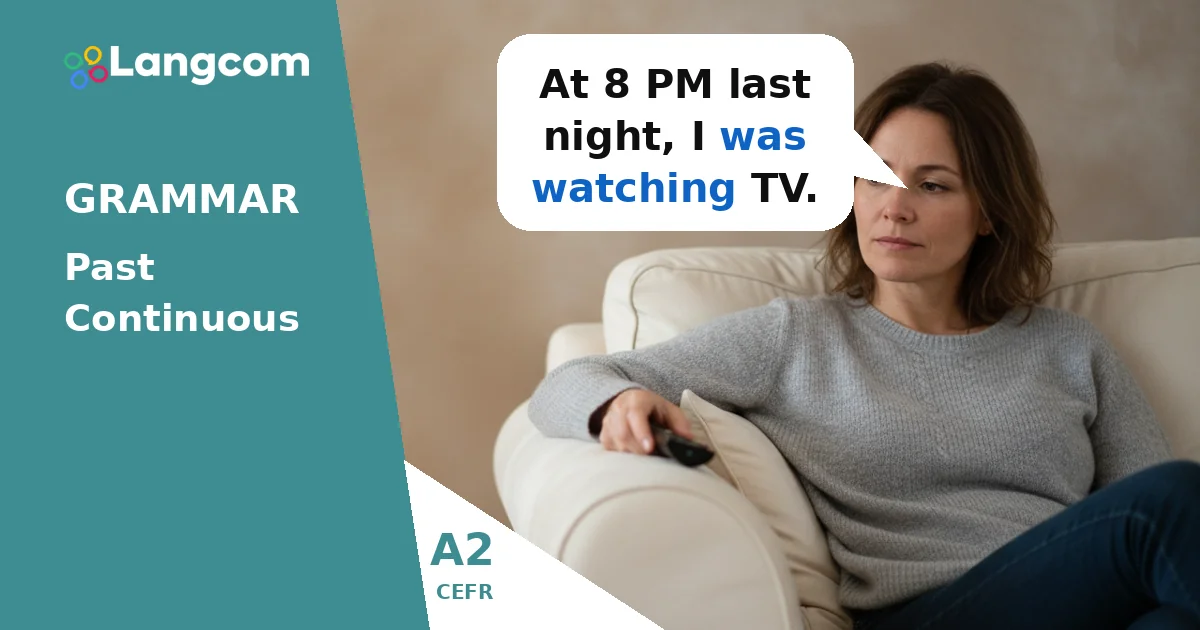

What is the Past Continuous Tense?
Сайт Past Continuous tense helps us talk about actions that were happening in the past. Think of it like a “snapshot” of an action in progress at a specific moment before now.
It shows that an action started before a certain time in the past and continued after it. The action was not finished at that specific past moment.
✍️ Not sure which level you are?
Take our free placement test and get personalized feedback from certified Cambridge examiners.
Пройдите наш БЕСПЛАТНЫЙ тест на определение местаHow Do We Form the Past Continuous?
To make the Past Continuous, we use the past form of the verb to be (was или were) and the -ing form of the main verb.
- Для I, he, she, it, we use was.
- Для you, we, they, we use were.
When Do We Use the Past Continuous?
Мы используем Past Continuous in several situations to describe past actions.
- To describe an action in progress at a specific time in the past:
This is for actions that were happening at a particular moment. The action started before that time and continued after it.
- To describe an action interrupted by another action:
We often use the Past Continuous for the longer, ongoing action and the Past Simple for the shorter, interrupting action. We often use words like when или while.
- To describe two or more actions happening at the same time in the past:
When two actions were happening simultaneously, we use the Past Continuous for both. We often use while to connect them.
- To set the scene or describe background actions in a story:
This helps to paint a picture of what was happening around the main events of a story.
Past Continuous vs. Past Simple: What's the Difference?
It is important to understand the difference between the Past Continuous and the Past Simple.
- Сайт Past Simple describes completed actions in the past. It focuses on the action as a whole, from beginning to end.
- Сайт Past Continuous describes an action that was in progress at a specific point in the past. It focuses on the duration or the fact that the action was not finished.
| Тема | Form |
|---|---|
| I / He / She / It | was + verb-ing |
| You / We / They | were + verb-ing |
| I / He / She / It | wasn't + verb-ing |
| You / We / They | weren't + verb-ing |
| Was I / he / she / it + verb-ing? | |
| Were you / we / they + verb-ing? |
Примеры
- At 8 PM last night, I was watching TV.
- She was cooking dinner when the phone rang.
- While they were playing football, it started to rain.
- My brother was sleeping when I arrived home.
- The birds were singing, and the sun was shining.
- What were you doing at 3 o'clock yesterday afternoon?
- I wasn't listening to the teacher.
- Were you working late last night?
Практика
Ready to earn your certificate?
Langcom prepares students for Cambridge, IELTS, TOEFL, DELE, SIELE and Michigan exams.
Get started with LangcomРаспространенные ошибки у носителей испанского языка
Люди, говорящие по-испански, иногда допускают ошибки с Past Continuous because of differences with Spanish verb tenses.
- Использование Past Simple for ongoing actions:
In Spanish, the simple past can sometimes imply an ongoing action. In English, we need the Past Continuous for this.
Wrong: I studied when you called. (Sounds like you finished studying then)
Right: I was studying when you called. (Shows the action was in progress) - Incorrect auxiliary verb:
Remember to use was for singular subjects and were for plural subjects.
Wrong: They was playing.
Right: They were playing. - Forgetting the -ing form:
Сайт -ing ending is essential for the continuous aspect.
Wrong: She was eat.
Right: She was eating.
Часто задаваемые вопросы
What is the main use of the Past Continuous?
The main use is to talk about an action that was happening at a particular moment in the past, or over a period of time, as in I was reading a book all evening.
How is the Past Continuous different from the Past Simple?
Сайт Past Simple describes actions that are finished. The Past Continuous describes actions that were in progress at a specific time in the past, or were interrupted. For example, I walked to school (finished action) vs. I was walking to school when I saw my friend (action in progress, then interrupted).
Can I use the Past Continuous to talk about future plans?
No, we use the Present Continuous for future plans (e.g., I am meeting my friend tomorrow). The Past Continuous is only for actions happening in the past.
Is the Past Continuous important for the A2 Key (KET) exam?
Yes, understanding and using the Past Continuous is very useful for the A2 Key exam. You might need it in Part 6, the story writing task, to describe background actions or events happening at the same time.

0 Комментариев