

What Are Weak Forms in English?
Weak forms are the reduced, unstressed pronunciations of certain words in spoken English. These words are typically ‘function words’ that carry grammatical meaning rather than main content.
- They often change their vowel sound to a schwa /ə/, like the ‘a’ in about.
- Sometimes, a sound can disappear completely (elision), especially ‘h’ sounds or certain vowels.
- Strong forms, in contrast, are the full, stressed pronunciations, used for emphasis or when a word is spoken alone.
Why Are Weak Forms Crucial for C1 Listening?
At the C1 level, you need to understand English spoken at a natural pace, which always includes weak forms. If you expect every word to be pronounced in its strong form, you will struggle to follow conversations.
- Recognizing weak forms helps you process spoken English faster and more accurately.
- It allows you to distinguish between what is important (stressed content words) and what is less important (unstressed function words).
- This skill is vital for understanding lectures, complex discussions, and media content where speakers use natural, connected speech.
Which Words Weaken in Complex Verb Phrases?
Complex verb phrases often contain several function words that can weaken. The most common are auxiliary verbs, prepositions, and sometimes pronouns.
- Auxiliary Verbs: have, has, had, do, does, did, be (is, am, are, was, were), will, would, can, could, must, should.
- Prepositions: of, for, to, at, from.
- Conjunctions: and, but, or.
- Pronouns: him, her, them, us (when unstressed and part of a phrase).
In phrases like should have been doing, each auxiliary verb (should, have, been) will likely take a weak form.
How Do Weak Forms Sound in Connected Speech?
The sound changes are predictable once you know what to listen for. The most common changes involve the schwa sound and consonant reductions.
- have often becomes /əv/ or /v/ (e.g., could have → /kʊd əv/ or /kʊdə/).
- to often becomes /tə/ (e.g., going to → /gəʊɪŋ tə/ or /gɒnə/).
- of often becomes /əv/ or /ə/ (e.g., cup of tea → /kʌp əv tiː/).
- and often becomes /ən/ or /n/ (e.g., fish and chips → /fɪʃ ən tʃɪps/).
- ‘H’ sounds can be dropped, especially in him, her, has, had (e.g., I saw him → /aɪ sɔː ɪm/).
These reductions blend words together, creating a smoother flow of speech.
示例
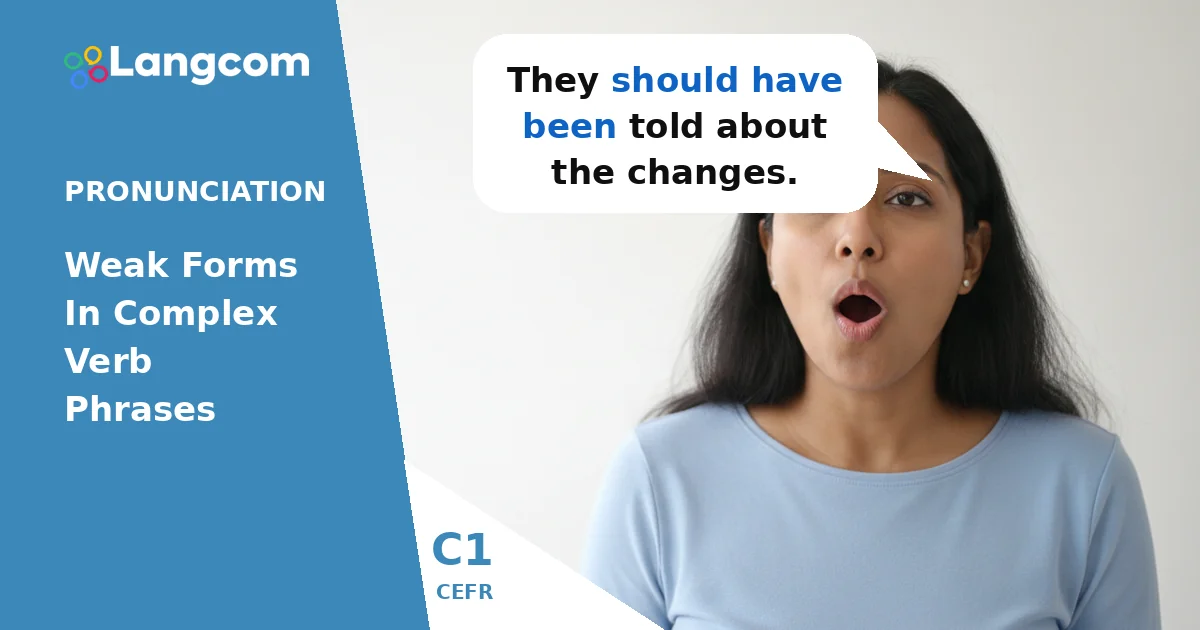
- They should have been told about the changes. (should have been → /ʃəd əv bɪn/)
- He must have been working late. (must have been → /mʌst əv bɪn/)
- We could have gone to the party. (could have gone → /kʊd əv gɒn/)
- She’s going to be studying all weekend. (going to be → /gɒnə bi/)
- What do you want to do for dinner? (do you want to → /dʒə wɒnə/)
- I’ve been waiting for an hour. (for an → /fər ən/)
练习
西班牙语母语者常犯的错误
西班牙语学习者常犯的错误
Spanish speakers often pronounce every word in English with its full, strong form. This is because Spanish typically has clearer, more consistent vowel sounds and less vowel reduction in unstressed syllables.
- Over-articulation: 谚语 I should have been there as /aɪ ʃʊd hæv biːn ðeər/ with full stress on each word sounds unnatural and can make your speech difficult for native speakers to process.
- Difficulty with listening: Expecting to hear every word clearly can lead to misunderstanding or frustration when listening to fast, natural English, where should have been is often reduced to /ʃəd əv bɪn/.
- Missing the ‘flow’: The rhythm and intonation of English rely heavily on the contrast between stressed content words and unstressed weak forms. Ignoring weak forms disrupts this natural flow.
To overcome this, focus on identifying the main stressed words and allowing the function words around them to reduce.
常见问题
When do weak forms NOT occur?
Weak forms are not used when a word is stressed for emphasis. For example, if you want to correct someone, you might say No, I DID go! (strong form of did). They also don’t occur at the end of a sentence or when a word is spoken in isolation.
How can I practice listening for weak forms?
Listen to authentic English materials like podcasts, movies, and TV shows. Pay close attention to how native speakers connect words. Try shadowing, where you repeat what you hear immediately after the speaker, mimicking their rhythm and intonation. Focus on auxiliary verbs and prepositions in longer sentences.
Are weak forms important for C1 English exams?
Yes, for C1 exams like Cambridge C1 Advanced (CAE) or IELTS, understanding weak forms is crucial for the listening section. It also contributes to a more natural and fluent-sounding pronunciation in the speaking section, demonstrating a higher level of proficiency.
Do all native speakers use weak forms?
Yes, weak forms are a fundamental part of natural, connected speech in all major English accents (British, American, Australian, etc.). While there might be slight variations, the principle of reducing unstressed function words is universal among native speakers.



0 条评论